Most pet owners who ask about HEPA filters are thinking about the air purifier in the corner of the living room. That's a reasonable starting point. It only addresses half of how pet allergens move through a home. The other half lives in your floors.
What Pet Allergens Actually Measure
The particles that trigger pet allergies are not pet hair. Hair is large enough — typically above 50 microns — that almost any filter catches it. The sensitizing substances are proteins: Fel d 1 in cats, Can f 1 in dogs. These proteins bind to shed skin cells and microscopic debris, producing particles that commonly range from 1 to 10 microns when freshly aerosolized, with a significant fraction falling below 2.5 microns.
Research published in the Journal of Allergy and Clinical Immunology found that a substantial portion of airborne cat allergen is carried on particles below 2.5 microns in diameter — small enough to remain suspended in indoor air for hours after a cat moves through a room. The American Academy of Allergy, Asthma & Immunology notes that cat allergen can persist in home environments for months after the animal is no longer present, because fine particles settle and re-enter suspension with foot traffic, HVAC cycling, and cleaning activity.
Dog allergen distribution is broader, with more mass in the 5–10 micron range, but concentrations still land heavily in the PM2.5 fraction in multi-dog households.
Where Standard Filters Fall Short
MERV 11 filters — among the more common mid-grade options in residential air purifiers and HVAC systems — capture 65–80% of particles in the 1–3 micron range and around 20–35% in the 0.3–1 micron range. A meaningful fraction of pet allergen particles pass through on every air cycle.
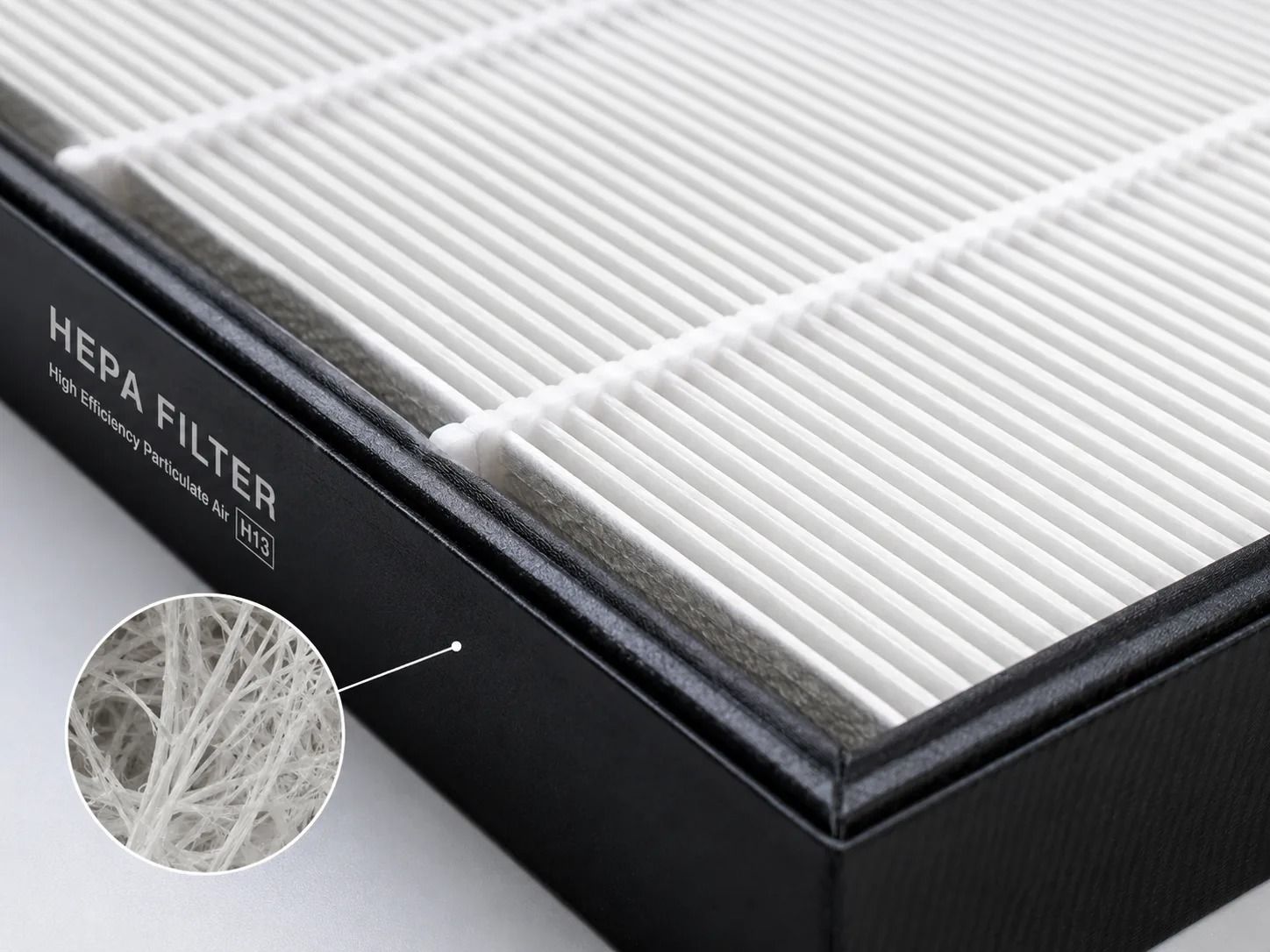
H13 HEPA filtration under EN 1822:2019 requires 99.95% overall efficiency at the Most Penetrating Particle Size of 0.3 microns. That means the entire size range relevant to pet allergens is captured at substantially higher rates. The efficiency gap is largest exactly where pet allergen concentrations are highest — the sub-2.5 micron fraction.
"HEPA-type" labeling on consumer air purifiers doesn't change this. The designation is unregulated and carries no verified efficiency requirement at any particle size. A filter marketed as HEPA-type may perform closer to MERV 8 than to certified H13, and there's no testing obligation that says otherwise.
Why Vacuuming Is the Second Variable
Pet allergen doesn't stay airborne indefinitely. Gravity pulls particles down, and they accumulate in carpet fibers, upholstered furniture, and along baseboards. This settled reservoir is stable — until something disturbs it.
Vacuuming without a HEPA filter is one of the most effective ways to return those settled allergens to the air. A study from the University of Guelph found that vacuuming with standard equipment elevated airborne allergen concentrations for up to 20 minutes post-cleaning. The exhaust airstream from the vacuum motor bypasses or passes through the filter bag and returns fine particles directly to the breathing zone.
A sealed HEPA vacuum — where the filtration path includes a certified H13 or H14 filter and no bypass gaps around the housing — eliminates that re-aerosolization problem. The same applies to robotic vacuums, which run on frequent low-clearance cycles and can continuously redistribute fine particles in pet households if the onboard filter doesn't retain them. HIFINE manufactures replacement filter media for robotic vacuum and smart home filtration platforms to H13 specification, and for conventional vacuum cleaner OEM applications where sealed HEPA performance is required.
Other particle sources compound the problem. Cooking on induction cookers, burning candles, and running forced-air heating all elevate indoor PM2.5 load — and in pet households, the baseline particulate concentration is already higher. A two-filter strategy addresses the cumulative burden rather than one variable in isolation.
When HEPA Grade Is Worth It vs When It Isn't
- Diagnosed pet allergies or asthma triggered by animal dander: H13 HEPA in both the air purifier and the vacuum is the evidence-based position. The U.S. EPA classifies pet dander as a primary indoor allergen and notes that effective management requires reducing particle concentrations across multiple air cycles and surface contact points — not just filtering a single room.
- Pets in the home, no allergy symptoms, hard-floor surfaces: A MERV 13 air purifier filter and regular vacuuming may be sufficient. Hard surfaces don't accumulate allergen reservoirs the way carpet does, so re-aerosolization is less of a driving factor.
- Multi-pet households or tightly sealed indoor environments: H13 HEPA in both positions becomes more important regardless of allergy status. Allergen load is roughly additive with animal count, and limited air exchanges mean indoor concentrations don't dilute between cleaning intervals.
Replacement Intervals Are Shorter in Pet Households
Standard manufacturer guidance typically recommends HEPA filter replacement every 12 months. In active pet households — especially with multiple animals or heavy shedding breeds — a 6–8 month cycle is more realistic. Visible discoloration on the filter face is a lagging indicator; filter resistance increases and capture efficiency degrades before the surface looks dirty.
The question "do I need a HEPA filter for pets" has a more precise answer than a flat yes or no. The air purifier addresses the airborne fraction. The vacuum addresses the settled fraction. Both matter, and the filter grade in each position determines whether pet allergen is being captured or redistributed.